Showing posts with label Elementary Camp. Show all posts

Thursday, May 10, 2012

Camp Grace Summer Camp Registration is underway!

June 22-24   Look Up Lodge  • Travelers Rest, SC  
$120 (A minimum $50 payment is required with registration.)
Elementary Summer Camp is a three day, two night getaway for completed 3rd–4th graders (by summer 2012) to experience their familiar Camp Grace program in the setting of REAL CAMP! Nestled in the beauty of the Carolina mountains, Look up Lodge is the perfect setting to learn and grow in our faith. Your kids will enjoy Bible study, lots of laughter, high adventure recreation, crazy camp competitions, and worship that encounters God in an unforgettable way!
Our theme this year will be “OVERBOARD!” Campers will study the Biblical story of Jonah, and will be amazed at how this crazy Old Testament story applies to our lives today. In both big group and small group settings, this theme will provide a platform for children to grow in their understanding of obedience and what it means to trust and follow God.

Thursday, March 8, 2012

Save the date! Elementary Camp - June 22nd-June24th

Calling all 3rd and 4th grade parents!
Mark June 22nd-June 24th for the Grace Church Elementary Camp at Look-up Lodge.  More details will be available in the coming months. 

Monday, July 18, 2011

Delivering Consequences

While at the 3rd & 4th grade camp at the end of June at Look Up Lodge, I observed some actions and conversations that sparked some ideas! I got to stay in a mainly rising fourth grade girls' cabin. I am going to school for elementary education, so this was a great experience for me to tie into that.

While walking around the camp, I overheard a lot of conversation among even some of the younger girls that was a real reality check for me. Some examples of what I heard were several girls talking about some very secular music and how they were getting access to it. Several of the girls were somewhat bragging about getting on YouTube when their parents weren't home, or sneaking this type of music onto their iPods and hiding it from parents. I felt that I was in a unique position; I felt the girls viewed me not quite as an adult because I am only twenty, but still respected me. With this being said, they were not as cautious to say these things in my presence. I took that opportunity to explain to them why it was wrong to not only listen to those types of artists, but to then hide it from their parents. A good piece of scripture to apply and share in this type of situation is Proverbs 13:1 "A wise child accepts a parent's discipline; a mocker refuses to listen to correction." Expressing this concept to your child can be extremely beneficial. Also, Proverbs 15:5 states, "Only a fool despises a parent's discipline; whoever learns from correction is wise." This displays the importance of understanding and accepting a parent's discipline.

This past Spring, I took a course on educational psychology at Clemson University by Dr. Brent Igo. The class focused mostly around the way children think, act, react, learn, and how we are to interact and deal with them. A section of the class that I was reminded of when I came upon these issues at camp was the topic of consequences - the different types of consequences and when to use them.

There are four main ways to deliver consequences: positive reinforcement, negative reinforcement, positive punishment, and negative punishment.
  1. Positive reinforcement - giving your child something to increase a behavior. For example, if your daughter has been struggling with her quiet time, you can give her a devotional plan to encourage increasing her quiet times. With this example, you want to try to avoid your child relying too much on you for guidance.
  2. Negative reinforcement - taking something away from your child to then increase a behavior. An example of this would be if, like at camp, your child was hiding their music selections from you. You could take away their iPod to increase their obedience towards you.
  3. Positive punishment - giving your child something to decrease a behavior. For example, if your son is showing a lack of respect and honor towards his counselor at camp, you can give you child examples of how he should have acted to decrease the bad behavior in return.
  4. Negative punishment - taking something away from your child to decrease a behavior. This is probably the form that is most familiar with you. A common example of how this can put into effect would be if your child is disobeying your rules, you in return take away play time or friend opportunities to then decrease the disobedience.
Using these techniques, paired with scripture and supporting your children by being a good example of following Christ, can influence them and what they think more than you may realize. I strongly suggest having more specific and honest conversations with your child about these and other related topics. Also, I feel that giving personal examples when you have struggled with the same problem would be very beneficial. Follow up with ways to fix the problem by pointing your children closer to God through scripture and spiritual context.

Recommended Scripture:
Colossians 3:19-21 "Husbands, love your wives and never treat them harshly. Children, always obey your parents, for this pleases the Lord. Fathers, do not aggravate your children, or they will become discouraged."
Ephesians 6:1-3 "Children, obey your parents because you belong to the Lord, for this is the right thing to do. 'Honor your father and mother.' This is the first commandment with a promise: If you honor your father and mother, 'things will go well for you, and you will have a long life on the earth.'"

- Michelle Phillips, Children's Ministry Kairos Intern

Monday, July 11, 2011

Scriptural Basis for Elementary Camp Teaching


Our teaching at 3rd & 4th grade camp a few weekends ago (June 24-26) centered around the theme "Are You 4 Real?" The concept of real relationships with God and with others was fleshed out through the four main sessions - Real Faith, Real Family, Real Friends, and Real Life. You can check out an overview of each session here.

We have had interest in the scriptural basis for the teaching, so below is an overview of each session. Let us know if you have questions, or would like further clarification.


Theme Verse: Colossians 3:3 "For you died to this life, and your real life is hidden with Christ in God."


Session 1: Real Faith
Big Idea - The reason life is hard and frustrating sometimes is because God wants us to need Him and trust Him.
Scripture - Colossians 3:3; Proverbs 3:5-6; John 10:10
Gospel Story - Luke 19:1-10 (story of Jesus' encounter with Zacchaeus)


Session 2: Real Family
Big Idea - God placed you in your family on purpose, because He loves you and wants what is best for you.
Scripture - Genesis 1:26; Genesis 2:18-23; Acts 17:26
Gospel Story - Luke 2:40-52 (story of Jesus' encounter with His parents)


Session 3: Real Friends
Big Idea - Real friendship doesn't depend on others, it depends on you.
Scripture - Ecclesiastes 4:9-10, 12; Philippians 2:2-5
Gospel Story - Marks 2:1-12 (story of Jesus' encounter with a broken man and his four friends)


Session 4: Real Life
Big Idea - Real life can never be lived in your own strength.
Scripture - Colossians 3:3; 2 Corinthians 5:17
Gospel Story - Matthew 19:16-26 (story of Jesus' encounter with the rich young man)

Sunday, July 3, 2011

"Are You 4 Real?" - Recap of Elementary Camp

After your rising fourth and fifth graders returned home from camp last weekend, you are possibly asking yourself “now what?” I feel confident you have heard all about camp - zip-line, swing, and big group games. Besides these things, I hope you have heard from your child about the real relationships and real life they learned about at camp this past weekend. The theme of camp was “Are you 4 real?- Real Faith, Real Family, Real Friends, Real Life.” I feel a recap and overview of what your child was taught at camp will be beneficial for you as a family. By understanding what was taught at camp, you can reflect on these issues and apply them, based on the needs of your family.

On Friday night, Ed Sweeny talked about what it means to have real faith. He introduced the idea on\f how God created us for relationships, but the most important relationship we can have is a relationship with God Himself. Our other relationships mean nothing without this relationship. The truth about our hearts is that we naturally and normally want what we want, and not what God wants. Once we acknowledge our sin, we see our need for a relationship with God.

On Saturday, we talked about one of God’s greatest inventions- family. God has placed your family together for many good reasons. Your family is designed to complement each other for a purpose, and to help each other through hard times. Ed talked about three things your children will learn from you, the parent. First of all, it is the first example they see of authority. This authority provides security, as well as preparation for the rest of their lives. Second of all, they can see God’s love for them through the blessing of parents. Not only that, but they learn how to love by the way you love them! Lastly, they learn responsibility through the role each member of the family plays. Whether it’s feeding the dog, taking out trash, or helping with cleaning, your child will understand what it feels like to be relied on and liable for something getting done. Siblings teach each other way more than you see on the surface! Siblings are normally the first friends your child will have. From this relationship, they learn how to share, how to forgive, and how to love. A family shows each member who they really are.

On Saturday night we talked about the importance of real friends. The making of a real friendship doesn’t rely on the other person, but on us. In a friendship, we are known, heard, and loved. We need friends to disciple us and guide us on issues that we cannot get through alone. 

By tying all of this together on Sunday, we saw how to live a ‘Real Life’ can be achieved. Through a relationship with our Creator, we can achieve real friendships with family, friends, and siblings!


-Caleb Phillips, Children's Ministry Kairos Intern

Tuesday, June 28, 2011

Elementary Camp at Look Up Lodge


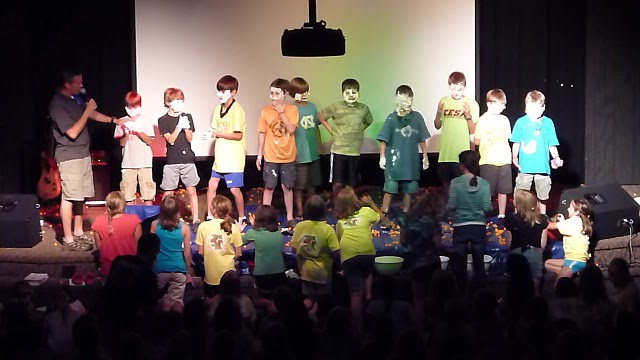
Well, we made it through the weekend for 3rd & 4th grade camp! We had 127 kids and about 40 leaders at Look Up Lodge for the weekend, where we learned about what it looks like to have a real relationship with God and with others. We played games and ate s'mores around a bonfire. We also saw the Exterminators save camp from being destructed and turned into a Boy Band Training Facility by the Bonus Brothers, including a redemptive heart change in both Joe and Bo Bonus. And we enjoyed the beauty of God's creation, nestled up in the mountains. We hope that your child not only had a really fun time, but also experienced God in a fresh way during his or her weekend.

Check out this video from camp, put together by Travis Runion:

Thursday, June 23, 2011

Happy Camper?

When sending your child to camp this summer, whether it is to a summer-long camp or to the Camp Grace Summer Camp for a short weekend, there are several issues to contemplate and consider with your child.

All over the United States this summer, there will be around 10 million children attending some sort of organized summer camp; either a music camp, church camp, or sports camp, etc according to the American Camp Association (ACA). No matter what the circumstances, always prepare your child, not only physically, but mentally as well. Around 4% of the 10 million campers going away this summer are currently suffering from Separation Anxiety Syndrome (SEP). SEP usually occurs at “sleep away camps” rather than just day camps. Another 95% of the campers suffer from homesickness, which is completely different than SEP in that homesickness does not interfere with a child’s social ability at camp. Homesickness only causes loneliness and thoughts of home.

Although such a large percentage of campers suffer from these different types of anxiety, there are several solutions that you as a parent can try with your child.
  1. Speak with camp directors prior to arriving to camp, so they can come alongside to help your child work through any anxiety or homesickness.
  2. Build up your child, encourage, and personally connect with your child to help them see that you understand any anxiety they may have
  3. Include your child in the decision to go to camp, and where to go.
  4. Help your child understand that worrying about camp is a chance for them to look to God for help and to depend on Him. Philippians 4:6-7 is a good reminder! "Do not be anxious about anything, but in every situation, by prayer and petition, with thanksgiving, present your request to God. And the peace of God, which transcends all understanding, will guard your hearts and your minds in Christ Jesus."
  5. Don’t show your personal sadness in dealing with your child leaving, which can create more anxiety for your child. It is important for you to trust in God through this time as well, especially if it is the first time your child has gone to camp!
  6. Try to avoid prolonged good-byes.
  7. Avoid constantly reassuring your child. Help them learn on their own that they will be ok because they can depend on God. Remind them of God's sovereignty, that He is always with them, and He will give them comfort if they turn to Him.
  8. When you start to see any symptoms of SEP or homesickness, intervene early in reminding your child to trust in God, in order to guarantee the best camp experience for your child.
Since our 3rd & 4th graders are heading out to Summer Camp tomorrow, please consider these tips and more, many of which I read in "Happy Camper" by Kayla Mossien on the Parent Guide News site.


- Michelle Phillips, Children's Ministry Kairos Intern